What Does Flood Insurance Cover? Building, Contents and the Basement Gap
Flood insurance covers two things, and you buy them separately: the building (up to $250,000 for a home in most communities) and what’s inside it (up to $100,000 for your belongings). The standard version is FEMA’s National Flood Insurance Program (NFIP), and every NFIP policy on a single-family home, a 2–4 unit building or a condo unit uses the same contract, the Standard Flood Insurance Policy Dwelling Form. (Private flood policies exist too, with their own terms.) Standard homeowners and renters policies generally exclude flood damage, which is why a separate policy exists; check yours.
The short version of what trips people up: a basement is covered only for a short list of equipment, not for finished walls, carpet or furniture; belongings aren’t covered at all unless you bought contents coverage; there’s no money for a hotel while you’re out of the house; and the water has to meet the policy’s definition of a flood.
What FEMA’s Claims Show
We read every NFIP claim on a home since 2000 in FEMA’s public claims file, 1.49 million of them. In 18.6% of the claims on policies with building coverage, roughly one in five, FEMA recorded no building payment (leaving out records it codes as erroneous or deleted; a minority of these claims still paid something on contents). It records a reason for 186,066 of them (the rest say “other” or are blank), and three reasons account for nearly nine in ten:
- Not a flood under the policy (37%). FEMA’s code for this is “not actual flood.” The policy pays only for a flood as it defines one: water covering at least two acres of normally dry land, or at least two properties, one of them yours (see What counts as a flood below). A burst pipe or rain coming through the roof doesn’t qualify, and water pooling on your lot alone may not, unless it covers two acres or reaches another property too.
- Less than the deductible (29%). Building and contents each have their own deductible, and a claim that comes in under it pays nothing.
- No damage could be shown (22%). FEMA’s code is “no demonstrable damage”: the adjuster found no physical flood damage to pay for.
Two more numbers from the same file. In about one in four building claims on homes since 2018, the policy carried no contents coverage (24.9% of 304,645 claims), so nothing the household owned inside was insured against flood. And of the $64 billion the NFIP paid on homes since 2000, $10.9 billion (17%) went to contents, $52.2 billion to buildings and $0.9 billion to Increased Cost of Compliance.
How we counted: OpenFEMA NFIP Claims (v3), all claims with a year of loss from 2000 on, residential occupancy types (single-family, 2–4 units, single units in a larger building, mobile homes). A claim counts as unpaid on the building if the policy had building coverage and the building payment was blank or zero (blank payments carry FEMA’s non-payment reason codes 91% of the time; paid claims almost never do). The 2026 figures include some claims still open. Percentages in the chart are rounded. Reasons are FEMA’s “claim closed without payment” codes; the policy definitions quoted on this page are ours to explain them, not FEMA’s notes on individual claims.
Building Coverage: What’s Included
Building coverage (“Coverage A” in the policy) pays for flood damage to the house itself, up to the limit you choose (the most available for a single-family home is $250,000). That includes:
- The structure and its foundation, plus additions attached to it.
- Electrical and plumbing systems and fixtures, furnaces and radiators, central air conditioning, and water heaters.
- Appliances: refrigerators, ranges, stoves and ovens, built-in dishwashers and microwaves, garbage disposals.
- Permanently installed cabinets, bookcases, paneling and wallpaper; carpet permanently installed over an unfinished floor.
- A detached garage, up to 10% of your building limit (that amount comes out of the building limit, it isn’t extra, and it isn’t covered if the garage is used as living space, a business or for farming).
- Clean-up and debris removal.
How much you get back depends on the house. A single-family home that is your principal residence (you lived there at least 80% of the past year), insured for at least 80% of what it would cost to rebuild or for the $250,000 maximum, is paid at replacement cost: the cost to repair it, with no deduction for age. Even then, appliances, carpet and pads, outdoor equipment and a detached garage are paid at actual cash value (value minus depreciation), and on larger repairs the replacement-cost money comes only once the work is done. Second homes, 2–4 unit buildings and homes insured below the 80% line are paid at actual cash value (or, for an under-insured home, a proportional share of the repair cost if that is higher). A manufactured home that is your principal residence, at least 16 feet wide and 600 square feet, has its own rule if it’s destroyed: the lesser of its replacement cost or 1.5 times its actual cash value.
Contents Coverage: Your Belongings
Contents coverage (“Coverage B”) is optional, and you have to buy it on purpose. It covers personal property inside the building, up to $100,000: furniture, clothing, electronics, rugs, washers and dryers, portable or window air conditioners, freezers and the food in them (food spoiled by a power outage is covered only if flood damaged the power or cooling equipment at your property), and carpet laid over a finished floor.
- It pays actual cash value, not replacement cost. A ten-year-old couch is paid as a ten-year-old couch.
- Valuables are capped at $2,500 in total per loss: artwork, photographs, collectibles and memorabilia, rare books and autographed items, jewelry, watches, precious stones and articles of gold, silver or platinum, furs, and any personal property used in a business. Antiques are paid only for their functional value.
- Belongings must be inside a building; things in the yard or on a deck are never covered. In a building that isn’t fully enclosed, belongings have to be secured, and anything that floats away is treated as not secured.
Basements: The Biggest Gap
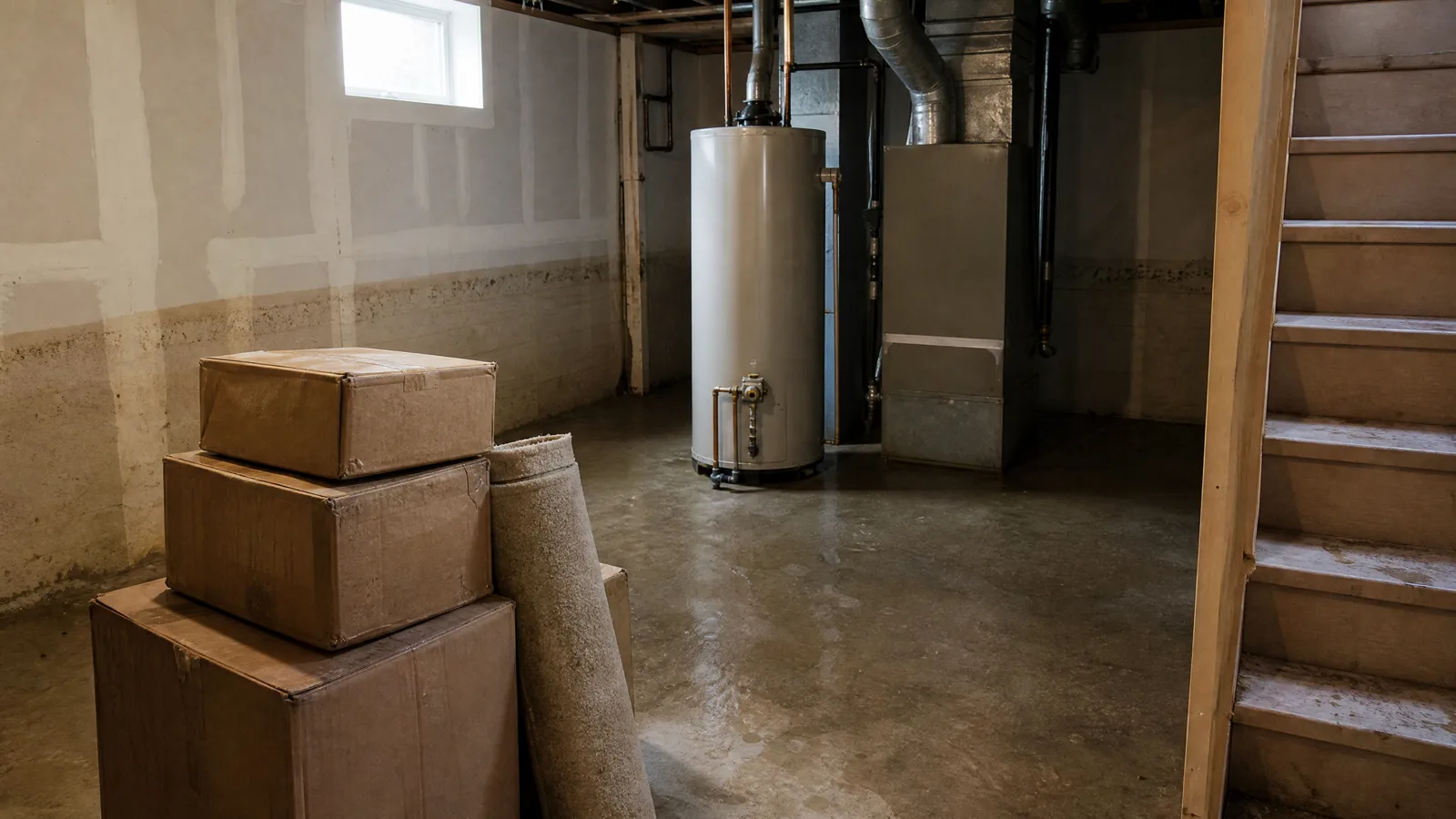
The policy defines a basement as any area with its floor below ground level on all sides, including a sunken room. In a basement, in any flood zone, coverage shrinks to a fixed list. The same list applies to the area under the lowest elevated floor of an elevated building built or substantially improved after 1974 or the community’s first flood map, whichever is later, in Zones A1–A30, AE, AH, VE, V1–V30 and the AR zones.
Covered there (building side)
- Furnaces, water heaters, heat pumps, central air conditioners
- Electrical junction and breaker boxes, outlets and switches
- Sump pumps, well water tanks and pumps, water softeners, filters and faucets that are part of the plumbing, and the utility connections these need
- Fuel tanks and the fuel in them; cisterns; solar energy pumps and tanks
- Stairways; foundation walls, footings, posts and piers
- In a basement, drywall and nonflammable insulation, but only as unfinished, untaped drywall nailed to the framing
- Clean-up
Covered there (contents side)
- Clothes washers and dryers
- Freezers and the food in them
- Portable or window air conditioners
Not covered there
- Finished walls (the taping, mudding and paint), finished floors and carpet
- Paneling, built-in shelving and other finishes
- Furniture, electronics, a home office or a playroom’s contents
- Anything stored there: boxes, tools, holiday decorations
If you have a finished basement, this is the part of the policy to read before a flood, not after. An NFIP policy won’t pay for what you keep down there, so moving it upstairs is the protection (or ask whether a private or excess flood policy covers it).
Extras Most People Don’t Know About
- Sandbags and pumps, up to $1,000. The policy repays reasonable costs of sandbags (and the sand), fill for temporary levees, pumps, plastic sheeting and lumber, plus your own labor at the federal minimum wage, when a flood is imminent and either water is already flooding the area or officials have ordered an evacuation. No deductible applies.
- Moving belongings to safety, up to $1,000, also with no deductible, and insured property stays covered at the new location for 45 days, as long as it’s placed above ground level or outside the high-risk zone, in an enclosed building or otherwise protected from the weather.
- Increased Cost of Compliance, up to $30,000, if your community’s floodplain rules require you to elevate, relocate or demolish a flood-damaged home (floodproofing qualifies only for some homes with basements and for non-residential buildings). It applies when repairs reach 50% of the home’s market value (“substantial damage”), or after two qualifying losses in ten years that each averaged 25% of its value, where the community enforces a rule for that. It comes with building coverage and has no deductible, but it counts toward the program’s $250,000 limit rather than adding to it: a home already insured for the full $250,000 gets nothing extra. It is paid once the work is done, which has to happen within two years.
What Flood Insurance Doesn’t Cover
- Somewhere to live. No payment for a hotel, rent or other living expenses while the home is repaired, and nothing for lost income.
- Cars, RVs, boats and aircraft (a car policy’s comprehensive coverage usually handles flood). A riding mower or similar unlicensed machine used on the property, kept inside, is an exception.
- Money and papers: cash, currency, securities, deeds, stamps and similar valuable papers.
- Land and landscaping: land, lawns, trees, shrubs and plants.
- Outside the walls: decks, patios, walkways and driveways outside the house’s exterior walls, fences, retaining walls, seawalls, docks, and tanks and other containers.
- Pools and hot tubs (unless the tub is a bathroom fixture) and their equipment, wherever they are.
- Underground structures and equipment, including wells and septic systems.
- Mold and moisture you could have controlled, including mold from failing to clean up and maintain the house after the water goes down.
- Sewer backup, sump pump overflow, seepage and water pressure on walls, unless a flood in the area is what caused it.
- Earth movement such as landslides, sinkholes, subsidence and gradual erosion, even when water set it off (mudflow is the exception: it counts as flood).
- Wind, along with fire and theft; wind damage is normally a homeowners or windstorm policy’s job.
- A flood already under way on the day you applied (for a policy bought at a loan closing, one under way before coverage began).
What Counts as a Flood
The policy pays for “direct physical loss by or from flood,” and it defines flood as “a general and temporary condition of partial or complete inundation of two or more acres of normally dry land area or of two or more properties (one of which is your property)” from overflowing inland or tidal water, an unusual and rapid accumulation or runoff of surface water from any source, or mudflow. It also covers collapse or subsidence of land along the shore of a lake or similar body of water, from erosion by waves or currents above their usual levels, that results in a flood.
You don’t have to be in a high-risk zone, and the water doesn’t have to come from a river. A heavy downpour that pools across a neighborhood counts. Water confined to your own lot and basement may not. In FEMA’s claims file, the most common recorded reason a home claim paid nothing on the building is “not actual flood,” and this definition is the test behind it.
When Coverage Starts
A new NFIP policy, or added coverage on an existing one, normally takes effect 30 days after you apply and pay. The exceptions:
- Coverage first bought in connection with making, increasing, extending or renewing a loan starts at the closing, if you apply and pay at or before closing.
- In the 13 months after a community’s revised flood map takes effect, a first policy starts the day after you apply and pay.
- Where FEMA has determined a property is affected by flooding from federal land made worse by a wildfire, a first policy bought within 60 days of the fire’s containment starts the next day.
After a flood, the policy requires a signed, sworn proof of loss within 60 days, plus an inventory of damaged property (the adjuster may help, but the deadline is yours). Practical advice beyond the policy: photograph everything, and keep damaged items until the adjuster has seen them or said you can throw them out.
Renters and Condo Owners
Renters can buy contents-only coverage, which pays for their belongings and, for a tenant, the stove and refrigerator they own. It can also cover improvements a tenant paid for, up to 10% of the contents limit (that amount comes out of the contents limit). Contents-only claims are rare in FEMA’s file: under 1% of home claims since 2000 (13,197 of 1.49 million), counting owners who insured only their belongings.
Condo unit owners can carry their own Dwelling Form policy alongside the association’s building policy (the Residential Condominium Building Association Policy). It can insure the unit itself, the owner’s belongings, and the owner’s share of a flood assessment by the association (not assessments from a government body or for the association’s own deductible). With contents coverage, it can also pay for the unit’s interior walls, floors and ceilings that the association’s policy doesn’t insure, up to 10% of the contents limit. A unit can’t collect more than $250,000 between the two policies.
Check Your Own Address
It’s the same contract in every flood zone (a few provisions, like the elevated-building limits above, depend on the zone); what mostly changes is the price and whether a lender requires it. Look up your address to see your FEMA flood zone, then read Do I need flood insurance? and what it costs.
Related: What is the NFIP?, Flood insurance in Zone X, Elevation certificates, Buying a house in a flood zone.
Sources: Standard Flood Insurance Policy, Dwelling Form, 44 CFR Part 61, Appendix A(1) (sections I–VII), as current in the eCFR when read on October 27, 2026; 44 CFR 61.6 (coverage limits) and 61.11 (effective dates); claims figures from OpenFEMA NFIP Claims v3, read October 27, 2026, including the fields nonPaymentReasonBuilding, totalContentsInsuranceCoverage and the amounts paid.
Check Your Property's Flood Zone
Free instant lookup using official FEMA data